Thursday, September 12, 2013

Day Five: You Cannot Be Replaced

This week, To Write Love on Her Arms asked people to answer the question, "Why can't you be replaced?"  I've actually assigned a similar journal prompt for my students in the past, and the replies were often heartbreaking and shocking.  It's an important issue for each of us to ask ourselves.  It goes beyond acknowledging what we're good at doing or what we provide for others or even who loves us.  Being irreplaceable gives our lives a deeper sense of purpose.   

I have a three-year-old daughter who has given me a deeper respect and appreciation of life.  It's not that I necessarily didn't enjoy living; she has just made life richer and more precious.  I know that I cannot be replaced in her life.  Yes, someone could meet her basic needs.  They could feed her, clothe her, provide for her.  Someone could even meet her emotional needs.  They could love her, encourage her, comfort her, support her.  But when it comes down to it, no one could replace me as her mother.  Her father loves and adores her.  Her grandparents think she absolutely hung the moon.  But I know that no one feels for her what I feel.  She grew inside me for nine months. I felt her first movements.  I rocked her to sleep before she ever took her first breath in this world.  I was the first person to hold her, to kiss her little face.  I love her in a way that I didn't know it is possible to love.  It doesn't mean I'm a perfect mom.  It doesn't mean I don't get angry or frustrated.  Actually, the fact that she's so much like me pretty much guarantees that I get angry and frustrated sometimes.  But I look at that little girl and know that there is nothing she could do that would make me love her any less.  I would go to any length to keep her safe and healthy and content.  If I were taken from this earth, I know she would be loved and I know she would be cared for, but there is no one who could truly replace me as her mother.  I don't say that to brag on myself or diminish anyone else's love for her.  I say it because it's just true.  

I cannot be replaced.

Everyone needs to know and to acknowledge why he or she can't be replaced.  It's important that we have a grasp on our worth in this world.  

Sometimes people begin to feel like they are a burden.  Or they feel like life doesn't have purpose, that they aren't important.  Depression lies and one of the biggest lies it tells is that you are worthless or meaningless.  

Some people don't feel irreplaceable.  They may even think their loved ones would be better without them.    

So here's my challenge to you today.  

First, I want you to decide why you absolutely cannot be replaced.  Then I want you to write it down, either privately or publicly.  Write it in a journal or on an index card.  Send it out in a Tweet. Leave it as a comment on this post.  But somewhere, write down why you are irreplaceable.  And if you can't figure out a single reason why you cannot be replaced, then you find someone who knows you, who loves you, and you ask them.  It may be awkward at first since that's not the kind of question one asks on a regular basis, but you find out why you cannot be replaced.  Because you can't.  

After you've done that, I want you to see out at least three people and tell them why they are irreplaceable.  You may do it face to face, over the phone, in a text, on a Post-It note, on their Facebook wall, wherever and however you'd like.  Tell someone why they cannot be replaced, what makes them original and indispensable.  Choose anyone you'd like to tell--a family member, friend, co-worker, the barista at Starbucks.  This is something we all can do.  I'm not asking you to talk about mental illness or suicide or anything that might make you uncomfortable.  I'm asking that you encourage at least three people in your life in a very important way.  

And if it goes well, then do it again tomorrow.  And the next day.  Make sure everyone you care about knows why you are valuable to them.  

You cannot be replaced.  

Say it.

I cannot be replaced.  

Now go make a difference.  Love to each of you.  

Wednesday, September 11, 2013

Day Four: Remembering Those We Lost


Today is the 12-year anniversary of the terrorist attacks on 9/11.  On social media, thousands have shared their memories of that day and have paid tribute both to those who lost their lives and those who risked their lives to save others.  I was teaching high school English that Tuesday morning and had arrived at school after the attacks began.  I was not watching as the second plane struck the tower.  In fact, the south tower had collapsed before I even knew there had been an attack.  My 2nd period class streamed in, some of them crying, asking me why I didn't have my television on. They talked all at once, about planes and explosions and falling buildings.  I went to my computer first, to verify that what I was hearing was true.  Before I could pull up the CNN website, one of my colleagues stuck her head into my classroom.  

"Have you heard?"

She quickly filled me in on what she knew.  I turned the television on and started watching.  The students continued to file into class and many of them gravitated toward the television.  Then one young lady said, "Please don't make us watch it.  Someone jumped.  We saw it."

I wanted to know what was happening in New York, but when I saw her face, I knew that it was more important that I turn off the television and just be there for my students.  

So the television was turned off.  The students sat down.  I took attendance.  And I let them talk and ask questions and comfort one another.  

Later that afternoon, I went home.  I felt a little like I'd spent the day in a time warp since I hadn't watched television and spent limited time on the Internet.  I immediately turned on the news and tried to piece together what had happened over the past eight hours.  I watched the plane crash into the tower, the fires burn, the buildings fall.  I listened to all the details, of the attacks in New York and in Washington, of the heroes who had lost their lives in a Pennsylvania field.  

And then I saw the footage that had upset the girl in my 2nd period.  I saw the people fall.  Or in many instances,  jump.  

I turned the television off.  I didn't watch again, limiting myself to written news and specific videos on the Internet.     

Of all of the images of that day, those of men and women falling to their deaths has stayed with me the longest and affected me the most.  

"Officially," no one actually jumped.  The lives lost that day were all homicides.  And I don't disagree with that ruling since none of them would have fallen from the building if it hadn't been attacked.  But there are witnesses who watched people leap from windows, some holding hands with others.  

I think about those people, looking down as the fire and flames closed in on them.  I can't imagine the fear, the pain, the hopelessness they felt.  They knew they would not be rescued from the heat and the suffocation.  They were desperate for fresh air, for an escape from the inferno that raged around them.  

I don't know their names or their faces, but I will never forget those images.   

This week is National Suicide Prevention Week, and I can't help but think again of those people. Please don't misunderstand.  I don't believe that those who jumped that day actually committed suicide in the sense that they chose to take their own lives.  Their lives had already been ripped away from them by those who hijacked the airplanes that September morning.  But when I think of the 36,000 Americans who give up each year, who leave behind friends and family to grieve, I have to wonder if they share some of the same feelings as those who stood in the broken windows of the Twin Towers on 9/11.  

I think about the husbands and mothers and sons and sisters who suffered with severe depression, with bipolar disorder, with so many mental illnesses that pushed them to give up on life.  I picture them in my mind, staring out a window, framed by broken glass.  They were afraid.  They were desperate.  They were hopeless.  They didn't know how to save themselves.  No one else saved them, though some may have tried in vain.  Death would be painful, but they believed it would be a release from the pain and suffocation of living.  They saw their lives as a burning building that couldn't be extinguished, only escaped at any cost.  

No one could save those poor men and women at the World Trade Center.  

There are so many lives that can be saved, though.  There are people who feel that same desperation. that same entrapment, that the victims of 9/11 felt.  They aren't surrounded by falling buildings and fires and news cameras, though.  They are sitting in the next cubicle at work.  They are staring at us from desks in classrooms.  We pass them on sidewalks, sit beside them at church, leave comments on their Facebook statuses, share meals with them.  Statistically speaking, right now there is someone you care about--a friend or a family member--who is struggling just to keep living.   And there are thousands and thousands more you do not know--that you'll never know--who are hurting, who are in need of help, of hope.  

IMAlive is an online crisis network where 100% of the volunteers are trained and certified in crisis intervention.  They provide 24/7 crisis support via chat.  There are three things you can do to help IMAlive to help those who are considering suicide:

1.  Spread the word.  Share IMAlive on your Facebook page, Twitter or blog.  Get the word out that help is available.  Don't assume that everyone in your life is "okay."

2.  Donate!  You can donate to IMAlive at any time, but right now you can participate in the IMAlive 24 x 7 Giving Challenge.  Your donation will cover operational costs or even pay for new volunteers to become certified so that IMAlive can continue to provide 24/7 care.  I've provided a widget below.  


3.  Volunteer.  If you'd like more information on becoming a crisis center volunteer, you may find information here.   This is not something everyone is called to do, but it is an opportunity to make a huge difference in someone else's life.  


Tuesday, September 10, 2013

Day Three: World Suicide Prevention Day

Today is World Suicide Prevention Day, a day set aside to raise awareness and to battle the stigmas that surround mental illness.  Events will be held in at least 60 countries around the world, with this year's theme being "Stigma: A Major Barrier to Suicide Prevention."  As I've written in my previous posts, the negative attitudes people have toward mental illness prevents those in need from seeking and receiving the treatment they need.  It dissuades friends and family from addressing their loved ones' mental illness and encouraging them to seek help.  In some cases, even ignorance or prejudice among medical professionals can prevent patients from receiving appropriate treatment.  

In order to reduce the stigma, we must all become more educated and more comfortable with discussing mental illness.  We must also become more comfortable listening to those who are in need and reaching out to those who may not ask for help.  

Below is a list of links I've complied that provide information on mental health and suicide.  Some are more general while others are geared toward certain groups such as parents or teens.  I've also included a list of links and phone numbers for crisis hotlines and chatlines.  It is not only essential that we become more knowledgeable and compassionate, but also to become familiar with where to turn to help if someone we know and love is in crisis.


IMAlive Online Crisis Center (chat instead of talk on phone) https://www.imalive.org
Youth America Crisis Hotline 1-877-YOUTHLINE
National Hopeline Network 1-800-442-HOPE
National Suicide Prevention LIfeline 1.800.273.TALK
Crisis Hotline (also for family members) 1.800.784.2433
Friendship Line 800.971.0016 (24 hour hotline for elderly and disabled and family members)


Several of these hotlines have opportunities for regular people to volunteer and help. With so many people in the world who are hurting--for that matter, with so many people right around us who are hurting--there is always someone who needs a compassionate ear.

If you are seeking additional information and have not been able to locate it, please leave a comment below, and I will be happy to research it for you.

Monday, September 9, 2013

Day Two: Stigma

I wrote a little bit about stigma in yesterday's post.  Even today, there is still so much ignorance and even discrimination when it comes to mental health.  Often, people who are suffering from mental illness know so little about their condition that they don't seek or receive the treatment which they need.   The stigma  may become shame when it is internalized by someone who is mentally ill.  Shame to seek treatment, shame to discuss their illness with others, shame to even admit to themselves that there is a problem.  

Aaron Moore is a licensed mental health counselor and co-founder of Solace Counseling in Orlando.  He recently wrote an article entitled "Challenging Stigma" for the website To Write Love on Her Arms.  What he has to say expresses my thoughts much more eloquently than I could, so I decided to share it here.  I think he is right on the mark when he says, "The more we walk through our struggles in silence, the more we deprive others of the benefit of knowing they are not alone."  If we were to remove the stigma of depression and mental illness and help prevent people from taking their own lives, those who are struggling should feel comfortable in sharing their stories and those who love and support them should be prepared and willing to listen.  

Please read on for the entire article from Mr. Moore:

If TWLOHA [To Write Love On Her Arms] were to update a status for this week, it would read that we feel “hopeful.” Much preparation has gone into 2013’s National Suicide Prevention Week, as it is a unique opportunity to address a topic so often neglected in our world. This week never ceases to be something beautiful, a chance to fight for the lives of loved ones, strangers, maybe even ourselves. At the same time, however, this week can feel like a necessary evil for many of us. It may remind us of those we’ve lost or of our own struggles. In this way, National Suicide Prevention Week is something we wish we did not need, but sadly, we have great reason to engage in. Which is why many organizations and groups are using this time to focus on the stigma and shame that keep these important conversations from happening.

We have said in the past that we know stigma is built on lies. It is founded and fed by the myths we believe about mental health issues and about those who struggle with them. Perhaps it is the lie that suicide only affects people who are “messed up,” the idea that depression only reaches those who are weak, or even the belief that if we share our struggles with someone, they will not understand or care. But the more we learn the truth about these difficult topics, the more we can bring it into the light and move toward healing and recovery, as well as the work of prevention. We have to learn that issues like depression, addiction, and suicide are not partial to weak people, but are struggles any of us may walk through, simply because we are human. We have to continue to filter the lies and myths about mental illness out of our society, replacing them with facts. This will go an incredibly long way toward eradicating the stigma that is still so prevalent. 
But just knowing the truth is not enough. While stigma may be founded on lies, it is also built within a social context, woven throughout the intricate fabric of our relationships. It is within our society and culture that the effects of stigma are felt. These effects range from the silence and shame surrounding mental health issues to the oppressive attitudes toward those struggling, even influencing the way treatment options such as therapy and medication are viewed. The powerful stigma attached to mental health communicates an illusion of separation between those who struggle and those who don't—a false dichotomy between the healthy and the sick. The damage this creates extends across our society and into each of our lives and relationships.  
As we work to reduce the stigma attached to mental health, we can learn much from the fight against the stigma connected with HIV. One main way it was reduced was through learning the truth about HIV—how it was transmitted, who had it, what treatment looked like, and more. This knowledge went far in combating some vicious lies that hurt so many in our society. But some research pointed to yet another component that proved powerful in greatly reducing stigma toward HIV: individuals who had a friendship or relationship with someone who was HIV-positive. Those with a personal connection to someone with HIV were drastically less likely to have a stigmatized, discriminating response.
What does this mean for us? It means we need each other. We need relationships and community around us. It means we have to continue listening to each other’s stories, and we must continue sharing our own. We need to know each other’s accounts of suffering, as well as our experiences of healing and recovery.
Thomas Joiner, one of the foremost researchers in the subject of suicide, has found that one of the most common thoughts present in those who are suicidal is the idea of being a burden on others. A second was that of being "hopelessly alienated, cut off and isolated from others”—a feeling of not belonging. Both of these speak to the power of our relationships and communities, whether or not we realize it.
The more we walk through our struggles in silence, the more we deprive others of the benefit of knowing they are not alone. Knowing the truth about the issues is vital, but we can get it from a textbook or Google in just a moment. Unless it is connected with real people, it lacks the power needed to combat stigma. We have to move beyond an awareness of the issues and become truly aware of each other.
Real relationships are the true antidote to the separation that stigma breeds between “healthy” and “sick.” Relationships require us to see the real person who is suffering, struggling, recovering, and healing. They are the place in which we find hope and encouragement to keep fighting, and the place where lies are defeated with truth and compassion. This is the path toward hope and healing—for ourselves and each other—and ultimately, toward a society where stigma, shame, and suicide are struggles of the past.  

Sunday, September 8, 2013

Day One: Statistics

This is part of a series of posts promoting National Suicide Prevention Week.


According to the Centers for Disease Control and Prevention, suicide is the 10th leading cause of death for Americans in general, with over 36,000 people taking their lives each year. Additionally,  between 400,000 and 500,000 are treated for self-inflicted injuries.  It's estimated that there could be as many as 900,000 attempts, though.

When I started looking at the breakdown of 2010 data from the AAS, here is what I noticed:


  • Every 13.7 seconds, someone loses hope and leaves behind family and friends.  
  • Men are 75% more likely to commit suicide.  Over 30,000 men took their lives in 2010.  
  • Of those 30,000, over 27,000 were Caucasian men.  
  • Women are three times more likely to attempt suicide.  
  • Based on estimates, someone attempts to end his or her life approximately every 30 seconds. 
  • While it is the 10th leading cause of death overall, suicide is the 3rd leading cause of death in Americans 15-24, following accidents and (only narrowly) homicides.  
  • 4,600 young people between 15 and 24 took their lives in 2010.  There were 267 more between 10 and 14.  That means that one young person took his or her own life every hour and forty-eight minutes.  
  • My home state of Tennessee is tied for 18th in the national rankings for suicide, with 943 deaths in 2010.  Wyoming topped the list with New York City and D.C. ranking at the bottom.
As I sorted through the data, I couldn't help but wonder why people aren't talking about this more.  If CNN or Fox News reported a new virus that killed 30,000 people last year including almost 5,000 children, teens and college students, wouldn't it get people's attention?  Wouldn't they post articles on Facebook?  Wouldn't it be a topic of conversation at dinner?   If parents were told there was an illness claiming children's lives at a rate of one each two hours, wouldn't mothers and fathers be desperate to find a cure, to protect their sons and daughters?  

Why aren't people talking about suicide?  Why is it such a taboo to discuss in "polite" society?  Yes, it's a terrible, depressing, traumatic event in the lives of any family or community.  It's not something we want to discuss.  But people must start talking beforehand in order to prevent the conversations that take place after someone has ended his or her life:

"If I'd only known he was that hopeless..."

"I wish she'd come and talked to me..."

"I didn't have a clue he was so depressed..."

"But I just saw her yesterday and she seemed fine."

"Didn't he know how much we love him?"


If 30,000 lives are lost each year to suicide and anywhere between 500,000 and 900,000 are directly affected by attempts, then chances are we all know someone who has been killed or hurt himself.  Factor in those who contemplate or plan but never attempt, and I dare say we all know someone who has been suicidal.  

So why aren't we talking?

Why aren't we talking about prevention?

Why aren't more survivors talking, both those who fortunately lived and those who were left behind?

Why aren't we taking it upon ourselves to become more educated, more knowledgeable in spotting the warning signs, in reaching out to those who are hurting?

We teach our children about "stranger danger" and "stop, drop and roll" and how to dial 911.  But what do we teach them to do if a friend comes to them and confides, "I want to kill myself."  

How many teenagers can quote a crisis hotline number?  For that matter, how many adults?  

Why aren't seminars being provided in communities for parents to learn about helping their depressed or suicidal teens?   Is it because there isn't a perceived "need" for this type of training?  Let's face it, most parents don't want to admit their kids have problems, especially ones big enough that outside help is needed.  

Why aren't teachers attending in-services that train them in spotting warning signs, in steps to take when a student is in crisis?  Aren't the safety and well-being of our young people just as important as Common Core and test data?  

Suicide has been in the spotlight more in the past few years, but the focus has been primarily on students who were bullied.  And while it is essential that we address bullying in our schools and through social media, we can't ignore the other factors such as depression and abuse that contribute to suicide among young people.  The youth in our country should feel comfortable talking about how they feel.  If we remove the stigma around talking about mental health, we create opportunities to reach these kids before they are completely hopeless and see death as their only option.  

And that doesn't just apply to young people.  

We're living in an age where anything you'd ever want to know is a Google search away.  There are countless resources about depression, anxiety, bipolar, personality disorders, and any other condition under the mental health label. But so many know so little about these illnesses that affect 1 in 4 adults in any given year.  According to NAMI, approximately 61 million people struggle with some form of mental illness, with an estimated 13 million of those living with bipolar disorder, schizophrenia or major depression.  

These are very real and, in many cases, very treatable illnesses.  But so many people suffer because they're too ashamed to see a counselor or fill a prescription at the local pharmacy for an anti-depressant or other psychiatric medication.  

It's estimated that over 90% of the people who commit suicide have some form of mental illness.  They aren't crazy. They have an illness.  Just like people with diabetes.  Just like people with Parkinson's.   Just like people with cancer.   But no one is wearing ribbons for them or organizing marathons or having bake sales to raise money for research and awareness.  

This is Suicide Prevention Week.  To prevent something you have to acknowledge it, to prepare for it, to talk about it.  

Talking doesn't cure cancer or AIDS or any other disease.  And it doesn't cure depression or bipolar disorder or anxiety.   But talking about mental health raises awareness and educates and draws attention to people are in desperate need of support and care.  And when those people feel like they have an illness they may discuss and not some dirty secret they have to hide, I believe we will see a decrease in the number of suicides in our country.  

We are hard-wired to live.  Self-preservation has been part of our human makeup since the dawn of time.  How lonely, how hopeless, must someone be to reach the point that he doesn't want to live, to essentially "override" his natural instinct to survive.  

No one should feel that alone.

Let's start talking.  Today.  Let's start a dialogue in our country and make people feel like it's okay to talk about what they are experiencing.  Let's talk in person and by text and through social media.   

We can be the vaccine in this epidemic.  Human kindness and compassion can provide a light in the darkness of another person's life.  

Let's talk now and not later.  Not at the hospital.  Not at the wake.  Not at holiday gatherings where a chair sits empty.

Let's talk now.  


I'll be posting information and resources throughout the week.  Please share.  Get the conversation started with someone you love.


You Cannot Be Replaced

Postcard from Postsecret

Today, September 8, marks the start of National Suicide Prevention Week. I understand that this topic makes some people uncomfortable, but it is something that has affected so many of us. This week is not just for those who are or have been contemplating suicide. It is also a time for all of us to become better educated, to build support networks, to reach out to the people in our lives that we love. Prevention begins with US. People who are hurting, who have lost hope, don't always reach out. And to be honest, we never know who around us is drowning. 

If you don't participate in any other way this week, I ask you to go out of your way to be kind. To your friends, to your family, to complete strangers. A smile, a word of encouragement, a card, an email, a touch, a hug... you never know when a seemingly insignificant act makes all the difference in the world. 

Lives are lost because people are afraid to speak out or don't know where to turn. They are afraid of how people will react, of the stigma it will attach to them. That's why I believe we MUST talk about suicide. No one should feel forced to hurt alone. This week, I'll be doing my small part by posting articles, resources and personal thoughts.  Please feel free to share anything that you find helpful, especially if you know someone who is hurting.  I invite you to help get the word out that NONE OF US CAN BE REPLACED.


Tuesday, September 3, 2013

Tuesday 10: Things I Never Imagined Coming Out of My Mouth

Motherhood has transported me to this bizarro parallel universe where I find myself cheering in the bathroom and counting to three constantly.  Well, to two, at least.  I've rarely made it to three, thank goodness.  

I think about the things I say to my daughter and how there is almost no situation where I would be considered a sane person if a spoke this way.   


"Listen, boss, I'm going to count to three and you'd better give me that promotion!"

"Hey, everyone in the grocery store line, let's play 'I Spy' to pass the time while we wait to check out!"

"Honey, if you will put your socks in the dirty clothes and take your necktie to the closet, I'll give you a special treat!" (Okay, okay, this could technically work if we're talking sexual favors and not marshmallows).  

But it gets worse and even stranger.  Sometimes I say things that make me stop and wonder if I'm high. Or if my toddler is high.  Or if I should worry that the words coming out of my mouth actually sound normal to my ears.   

In no particular order--and with no explanation or backstory--here are ten things that I never said prior to having a child:


  1. “Did you just pee on me?”
  2. “Please stop sticking that in your [insert orifice here]."  **
  3. "Where else did you smear the poop?"
  4. "Did you stick your head in the toilet?"
  5. "Did you stick your head in the toilet again?"
  6. "If you don't come sit down and put these shoes on right now, you aren't getting a popsicle for a week!"
  7. "Your boogers are not medicine now stop eating them!"
  8. "How the hell did applesauce get up here?"
  9. "Thank GOD you finally pooped!"
  10. "Where did you find the chicken nugget you're eating?"
What's the craziest thing you've found yourself saying to your kid?  


**I may have previously said this in a different context, but that's for a totally different blog.

Monday, September 2, 2013

I'm Not the Mean Mommy

I don't consider myself to be a judgmental mommy.  Unless we're talking about something that would be considered abuse or negligence, there are very few things that I will cause me to look at another parent and think, Perhaps you should have not reproduced.  Seriously, the list is pretty short.  I may shake my head when I see a mom pour Mountain Dew in her toddler's sippy cup.  I may roll my eyes when I hear a dad threaten to spank his son for the 37th time without ever actually getting up from his table and putting his phone down.  But as far as actually judging, I try to keep that in check.  I takes becoming a parent to fully grasp and appreciate what a challenge it is.  I never know when a parent is just having a really rotten day and doing whatever it takes to survive. Lord knows there are days I've broken 99% of my own parenting rules in a desperate attempt to avoid a melt down (Peanuts and/or my own).  

I do, however, get mad as hell at parents who make my kid think I'm a mean, awful mommy.

I'm not talking about parents who spoil their kids, the ones who buy every toy, every trinket, every random piece of plastic that their offspring desires.  

I'm not talking about the parents who indulge their kids, the ones who always buy them ice cream or candy bars or donuts or Red Bull.

I'm not even talking about parents who let their kids run wild or scream at the top of their lungs or talk back.  

I'm talking about parents who blatantly ignore the rules that all of the other parents--including me--are following, whether it be at the playground, the library, the zoo, wherever.  Rules such as:


  • No Climbing 
  • No Running
  • No Food or Drink
  • No Entrance
  • Do Not Feed the Animals
  • Children Must Be Accompanied by an Adult
  • Keep Out of Water
  • Do Not Touch
  • Line Starts Here
  • Please Keep Volume to a Minimum
  • No Children Over [insert age/size]
  • No Children Under [insert age/size]

This post is for THOSE parents.

Seriously, folks, these are rules that the establishment has posted in an effort to keep our children safe and to keep things orderly so that everyone can have fun.  It's not like this is about me pushing my morals or beliefs about parenting on to you.  I have no moral standpoint on running or feeding animals or whether or not a ten year old should be allowed in the area designated for toddlers.  I'm just trying to follow the guidelines laid out by the manages or administration.  Call me a sheep, but rules are just a necessary part of life.  

So when I've told my child she can't take her chocolate milk into the playground area or that she has to stay with me at the library or that she can't play in the water fountain because it's AGAINST the rules, it makes me look like a big, stinky meanie when she sees YOUR kids doing the completely opposite.  

"Pssshhh," you say, "those rules are arbitrary.  They're kids.  It's not hurting anything."  

What are you teaching your kid?  That they can pick and choose which rules they want to follow?   Can you see that backfiring at all?  

"Yes, Mrs. So-and-so, this is little Timmy's teacher.  I asked him to raise his hand before speaking out in class today since that's a classroom rule, and he told me that he's not hurting anyone by not raising his hand."  

Or it could look more like this:

"Um, hey, this is Timmy's teacher.  Today he informed me that he doesn't have to follow my rules because that's what Mommy said."

You know, it's your kid, so turn him into a little junior anarchist.  Whatever.  But in the meantime, you're making me look like a total dick in front of my kid.  She's three now and is already pointing out the injustice of having me as a mother.  She's paying more attention and noticing that there are kids who don't have to follow the so-called "rules" Mommy has been touting.  

And she doesn't like it.  

And when a toddler doesn't like something, they don't just dislike it a little.  Oh no, it can escalate into Defcon 2 1/2 in about 62 seconds.  

But it isn't just the written, established rules that some of you insist on crapping on repeatedly.  I will never understand parents who deliberately (at least it seems that way) allow or encourage their kids to do stuff that they hear other parents telling their children not to do.  

"Don't climb up the tube slide when other kids are trying to come down."
"Don't throw your snack into the animal's cage."
"Don't run beside the pool."
"Don't break in line to ride on the train."
"Don't climb up the outside of the playground equipment."
"Don't touch the statue."
"Don't fling your food across the table."
"Don't push that kid."
"Don't snatch toys from your friends."
"Don't take your shoes off."
"Don't take your clothes off."
"Don't open/go through that door."

Sometimes rules don't have to be posted.  They're common sense.  And when you as a parent hear me (and others) telling our children not to do these things, it's completely unfair for you to stand and watch your child doing them, especially if the child is old enough to know better or old enough to be setting an example for the little ones.  If I had a dollar for every time I've had to listen to my child say, "But she's doing it" or "But he did it," then I would just build my own playground and not put up with a lot of this mess.  

I know we all parent differently.  I know some of us are more laid back and others are more anal about things. Unfortunately, I tend to fall into the second category, especially when we're in public.  Regardless, parents should be united as much as possible.  We shouldn't undermine each other, even if we don't know each other.   We can't always know what every parent in the room expects from his or her child, but just use some common sense.  This is so important when kids of different ages are mixed together.  If there is an area designated for toddlers, please don't let you pack of middle schoolers run amok while the little ones are trying to play.  If the sign says that children must be under adult supervision, please don't leave them to their own devices while your Facebook from your phone.  If your kid is "hogging" a toy or activity, please make her share if she isn't inclined to do so.  Don't let your kid bogart the swing or a ride at Chuck E. Cheese for half an hour just because you are afraid of a confrontation.  
I'm tired of being the "bad mommy."  I'm tired of expecting my child to "do right" when half the kids around her are doing whatever floats their boat without any consequences.  Right not it just produces pouting and hurt feelings.  But what happens when these kids grow up?  What about when they hit high school?

"But his mom doesn't care if he drinks."

"But her parents don't care if doesn't make good grades."

"But so-and-so has a... [insert whatever expensive gadget is popular in 10-12 years]"

"But what's her name doesn't have a curfew."

"But everyone else's parents are letting them do it.?

Oftentimes, these pleas are total BS.  But there are many times when parents are more interested in being friends than in being parents.  And chances are they'll want to be friends with your kid, too.  

So if you've read any of this and it seems a bit too familiar, you're not a bad parent.  But you're making me a bad parent in the eyes of my child.  I'm okay with being the "bad cop."  I'm okay with enforcing rules.  But don't make me look like I'm just being an a-hole or keeping my daughter from having fun.  Let's help each other out and hold all of our kids to some sort of standards that are reasonable.  

There will always be days that we just "survive," the days when we're just happy that our kids aren't killing each other or maiming themselves.  But lets save those days for when they're necessary and actually raise our kids to follow the rules that are set to keep them safe and to allow all the kids to have fun.  

Even though I'm not in this to be my kid's "friend," I at least don't always want to be her nemesis.  


Friday, August 30, 2013

On Being a Stay at Home Momma

I spent the better half of a decade teaching public high school.  It was a challenging, often difficult career, but it was also fulfilling and rewarding since it wasn't just a career.  It was a calling.  I loved "my kids" even on the days I wanted to wring their moody, hormonal little necks.  I was protective of them and often felt like a substitute parent to many of them.

Pregnant Woman by Nooshin Zarnani
When I left my classroom in May of 2010, it was bittersweet.  It had been a long year since on top of the regular "teacher stuff,"  I'd also struggled with morning sickness (that often lasted all day), swollen ankles and feet, agonizing sciatica, untreated anxiety, and the regular exhaustion that comes with pregnancy.  I was ready to stay home, put up my feet and wait for my daughter to arrive in eight weeks.  But her arrival would also mean I wouldn't return to the classroom since I'd made the decision to stay at home with my little girl in lieu of returning to work. I was excited and thankful that I had the opportunity to be home with my daughter, but I also feared I might be unhappy and lonely and bored.  I knew women who admitted that they returned to work not out of necessity but because they didn't enjoy being home full time.  As the days crepppppppt by and I awaited my baby's arrival, my future as a SAHM became a source of additional anxiety.

Fast forward three years.

I'm sitting in the recliner with Peanut in my lap.  We're watching The Rescuers for the first time since it's one of her favorite bedtime books. Both of us are still in pajamas with unbrushed teeth and hair, even though it's almost one in the afternoon.  Our breakfast--well, brunch--plates are stacked on the end table, sticky with the remnants of homemade strawberry preserves I made this summer.  There is a tiara on my head and at least a dozen bracelets on my wrist.  Peanut is sporting a Rapunzel wig and every remaining piece of jewelry from her dress up box.  It has been a deliciously lazy day with my favorite small person.  Bored isn't on my radar, nor is unhappy, lonely or unfulfilled.

Every day isn't like this, though.  I never realized how busy I would stay as a SAHM.  I never imagined how stressed or frustrated or CRAZY I would feel.  It's not that I thought it would be easy, but I always visualized being this super hands-on mom and "on top of things" woman with a happy, well-rounded child, a clean house, home-cooked meals on the table each evening, and a free minutes left at the end of the day to write.

Surely I can handle one child and a home if I don't have to work outside the home, I thought.

Well, I can do those things.  Just not on the same day.

Love and Despair by Sandra Butler
There is nothing that can truly prepare you for the mind-numbing exhaustion of a newborn or infant.  There were days that my biggest accomplishment was not falling asleep and dropping my baby during feeding time.  Some weeks the only laundry I finished was cleaning poop out of her onesies.

There is nothing that can truly prepare you for the anxiety that accompanies a child in motion.  Even ten years of keeping an eye on 30 teenagers at once wasn't training enough for keeping track of one crawling 10 month old.  One time, I left the room for twelve seconds.  I know it was twelve because I later timed the same task.  During that minuscule frame of time, my child managed to seemingly disappear  from the gated living room.  Where did I find her?  Behind the entertainment center.   Cleaning the house?  Not likely unless I strapped her to me (not the safest option if I'm bleaching toilets) or stuck her in the Pack-N-Play (commence meltdown).  My clean house was limited to whatever rooms weren't closest to her during naptime and whatever tasks wouldn't wake her up (what's a vacuum?)  Making dinner was hectic and stressful with tiny, moving stumbling block maneuvering around the kitchen.  And by the time I got everything on the table, got Amelia fed, picked up her spoon 8,000 times, and made my plate, the food was cold and I wasn't even that hungry anymore.

And there is absolutely nothing that can prepare you for the roller coaster ride of spending 24 hours a day with a toddler.  They're like miniature tornadoes.  With vocabularies.  And attitudes.  It's a constant balancing act of learning, playing, teaching, disciplining, eating, napping, potty-training, reading, pretending, driving, scheduling, arguing, nurturing, and loving.  That's on top of the laundry and the grocery shopping and the cooking and cleaning and the sweeping and the wiping and... oh my Lord, did you really just dump out the entire contents of your toy box while Mommy was peeing???  Did you paint the couch with iced tea? Why did you kick the dog?  Why did you separate and throw all of the socks in your drawer?  Did you just stick your head in the toilet?  Why are your teeth blue and where is the rest of that crayon?  Don't climb up there, you'll get hurt!  Don't put that in your mouth, you'll choke!  Don't pull that on top of you!  Don't run with your toothbrush in your mouth!   Is this poop?  Where else is the poop?  

I know, I know, First World Problems.  

Look, I'm not saying I have it harder than working moms.  If I had to get up early every morning, go to work, teach all day, spend the afternoon grading and planning and STILL have to be a mom and homemaker, I would probably dig a hole, climb into it and beg passers-by to shovel in some dirt on top of me.  And even though it sounds like I'm complaining about staying at home with my daughter, I'm not.  That's kind of the point I'm trying to make.  Even though this has been a total challenge and I've lost more hair that I care to discuss, I wouldn't trade this life for anyone else's.  It's taken three years to get to a point where I don't feel like a constant failure because I always have more on my "to do list" than on my "done list."  I've had to give up on that "super mom" life I had planned and just focus on being the best mom I can be.  

I treasure being at home with my Peanut.  I love being her mother, her teacher, her best friend (at least she thinks I am for now... oh, how soon that will change).  I love getting to witness her milestones, to watch her accomplishments.  I love being the one she runs to when she's proud of herself, the one she reaches for when she falls down.  I start my days with her little gap-toothed grin and end my days with her arms around my neck.   For every tantrum or sassy comeback, there are ten "I lub you, Momma."  With every mess, there is a new adventure or memory to be made.  My house is dirty but my child is happy.  

I'll admit there are times I get lonely, that I miss being with adults.   There are days I wonder what it would be like to drop her off at day care and return to the land of working outside the home.   There are moments I feel like I'll drown in the lake of Legos and plastic food and princess crowns and puzzle pieces.  I've cried while I've picked Playdough out of the carpet.  I've cursed when I've heard her door to her room open for the 17th time after I put her to bed.  I've counted down the minutes until nap time.  I've called my mother to just come and TAKE THIS CHILD so that I can have a few minutes of rest (that I usually instead spend doing dishes or paying bills).  

But those moments are only a fraction of the rest of the life I have as a SAHM.  And I don't let myself get dragged down for too long when we do have a bad day.  

My baby turned three this year.  We are officially on the downward slope toward kindergarten and to my return to the workforce.  It hurts my heart to think about dropping her off at school each morning and not knowing what she's doing all day.  I will miss our lazy mornings, our late night cuddles and all the days spent in between just getting to be mommy and daughter.  I know how fortunate and blessed I am that I have this opportunity to spend her formative years with her, and I am in no hurry to return to the busy "adult" world that awaits me.  

Wrap 2 by Katie Berggren
I've managed to type this entire post on my Droid because I didn't want to give up snuggle time, but I had all of this on my heart and didn't want to lose that "momentum" that I seem to lack these days when it comes to writing.  I could have left her in front of the television and gone to the computer.  She would have finished the movie herself.  Blogging from a phone is most definitely not the easiest task.  But I didn't want to give up this time with her, even though we're doing absolutely nothing.  My life isn't boring; it's the biggest adventure I've ever had.  

The end of the movie is near, and I can feel her weight shift in my lap.  She's growing heavier and nap time approaches.  Who knows when I'll have the time or energy to write again.  Maybe tomorrow.  Maybe next week.  It's hard to say these days.  

But these days are so few and so precious.  


Friday, August 23, 2013

Finders, Keepers

She had just answered Final Jeopardy when her terrier jumped from the couch and scrambled to the front door, alerting Dolores with his tiny bark of someone's presence.  She assumed it was the postman preparing to deposit today's stack of bills, catalogs, and magazines into the mail slot.  Instead of the familiar sound of swishing envelopes, however, she heard the dog emit a low growl.  Maybe a cat or another dog, Dolores thought.

"Hush, Tipsy.  Mama's coming."

Dolores grunted as she pushed herself off of the sofa.  She wasn't an especially old woman or even a large woman, but life had weighed heavily on her shoulders for many years.  

Since Dolores hit puberty, there had rarely been a moment in her life in which she hadn't cared for someone.   
As a teenager, she tended to her younger siblings as her mother slowly succumbed to cancer.  In her mother's final months, Dolores took on the role of both parent and nurse.  Her insomnia could be traced back to those nights of lying in bed, awaiting the sound of her mother's moan, of her siblings' cries.  She would rock her younger brother as he struggled against her thin body, reminding her over and over through his sobs that she wasn't his Mama.  She would cover his ears as her mother would howl in pain, demanding Dolores "put the child down and come to her aid."  

The Dead Mother by Edvard Munch
Though it had been 47 years, Dolores still carried the secret shame of her initial feelings the morning she reached for her mother's hand and found it stiff and cold:  relief.  

Her mother had insisted that she not be embalmed, pointing out that her insides had rotted so there was no need to preserve what was left of her outsides.  Dolores knew that her mother's decision could also be attributed to the modest woman's repulsion of being naked on the table of the local mortician.  Dolores still cringed when she thought of bathing her dead mother’s body for the last time.

Tipsy was dancing a four-legged jig by the time Dolores reached the door, his nails tap-tap-tapping on the hardwood floor.  There still hadn’t been a knock.  Dolores pulled back the curtains beside the door.  There was a man sitting on her front porch steps.  His back was to Dolores, but his gray hair and posture indicated he was of advanced age.  His head was cradled in his hands.   Dolores couldn’t help but think of her father.

Jonas Wilbanks was not a bad man, but he had handled his wife’s illness and subsequent death very poorly.   His wife had always handled the children and household responsibilities, and being at home was overwhelming and frustrating.   He felt completely useless and, eventually, hopeless.  Instead of rising to the occasion and stepping up for his family, though, he avoided them and generally came home only to sleep and eat.  He justified his shortcomings in his own mind by increasing the financial provisions which he provided, requesting first consideration for any overtime at the factory where he was employed.  People around town criticized the man for practically abandoning his children and ailing wife, but Jonas kept his head down and worked harder.  The morning Dolores met him on the front porch with the news of his wife’s death, Jonas wailed and wept like her passing was a complete shock and surprise.   He was drunk for an entire week following her burial.  And the next week.  And then pretty much every day following, especially once the foreman’s sympathy waned and he fired Jonas Wilbanks.  

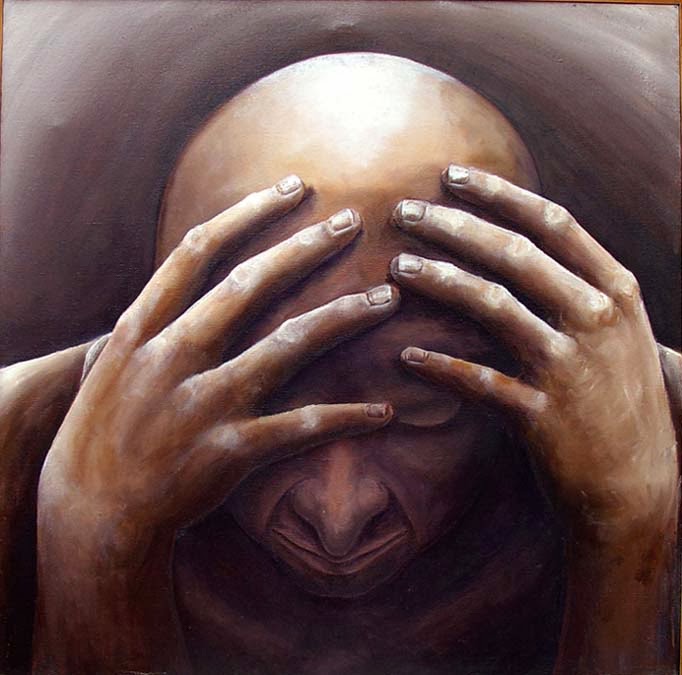
Hands on Head by Immortelle
Jonas was a broken man and would remain so the rest of his life.  Instead of starting a life of her own, Dolores remained at home, playing the role of mother to both the younger siblings and her own father.  Just shy of her 26th birthday, her youngest brother quit school, found work, and left home.  Dolores felt like a very old woman, and she felt older every time her Daddy would stumble home, often bloody and bruised.  She would lie awake as she had over a decade before, only this time it was her father who cried in the night.  When he’d grow quiet, she’d tiptoe down the hallway and find him sitting in her mother’s chair, asleep with his head in his hands.  

It took her two years to finally walk away and begin her new life.  

Dolores unchained and opened the door but did not cross the threshold.  Tipsy ran to the man and began giving him a once over with his tiny nose.  

“Sir?”

The man didn’t move, didn’t acknowledge her or the dog.  She noticed hearing aids on the back of his ears.

“Sir?” she said, a little louder this time.  

The man turned and looked up at her.  His face was friendly but lined with sadness.  He immediately grasped the handrail and carefully hoisted himself into a standing—yet slightly stooped—position.

He was dressed in a short sleeved button up shirt and wrinkled grey slacks.  His hair was silver but barely thinning as with most men of a certain age.  Behind his glasses were striking blue eyes, rimmed in red as if he'd been rubbing them profusely.  

Holding the rail, he made his way to the top step.  Dolores made no attempt to close the door or even back away. She couldn’t read minds, but she knew this man meant her no harm.

“Is there something I can help you with, hon?  Are you looking for someone?  Are you lost?  I have a phone—“  

“They told me you died, Bea.”

“I’m sorry?”

“They told me but I didn’t believe it.  I knew you’d be here waiting if I could just get to you.  But all those doors, those locks, those damned locks. I couldn’t get to you.”

“Sir, I think you are mistaking me for someone else.   My name is Do—“ 

But before she could finish, the old man covered the two steps between them much more swiftly than she imagined possible.  

He wrapped his arms around her.  She could feel his body convulse ever so slightly as he quietly sobbed into her shoulder.  Almost automatically, her arms embraced his body.  She patted his back and soothed him, shushed him.  

It had been so long since anyone had touched her, much less held her.  Her husband had been dead for almost six years, but she had no interest in dating and had politely declined when her friends tried to introduce her to "eligible" men.  

She had been blessed with almost three decades of marriage with her dear Erwin, but marriage had not provided the kind of escape she so desperately sought from her childhood home.  

Self 24 by David Roman
She and Erwin met after he returned home from his tour in Vietnam.  He never spoke of what he’d done or witnessed while he served his country, but Dolores had a hard time believing he’d been so broken prior to his deployment.  Erwin was a kind man, an honest man, and he loved Dolores.  But she often wondered if his love stemmed mostly from his dependence on her.  For days, sometimes weeks, Erwin would “go into himself” as Dolores called it.  He wouldn’t leave the bedroom, wouldn’t eat, often wouldn’t even speak or acknowledge Dolores was in the room.  She would endure these days of living with a shell of her husband by keeping busy—cleaning the entire house top to bottom, planting a new garden, baking pies and cakes for all of the neighbors.  She would only stop to sleep, eat and check on Erwin.  Each time, Dolores waited patiently for the door to open and for her husband to emerge, to hold her, to live again.  She would then make the most of the time they had together, forcing herself to focus on the life they were living and not the imminent threat of withdrawal that always loomed in the not so distant future.  

Then one day, the door never opened.  


Two hours later, Dolores found herself still entertaining—or rather being entertained by— the older gentleman whose name was Robert Tatum.  She had made coffee and found two honey buns in the pantry for them to eat.  He wore a bracelet with the name of a nursing facility only three-quarters of a mile from her own home, which was also Robert's former home with his wife.

She had not encouraged him to call her Bea, but she hadn’t corrected him since they met on the porch.  Though he was obviously the victim of some sort of dementia, he still possessed wit and charm.  He was currently reliving the early 80s and asking Dolores if she remembered the name of this chalet or that quaint cafe.   

The afternoon passed quickly.  Dolores made grilled cheese sandwiches and Campbell’s tomato soup for dinner.  She hid a grin when Robert mentioned that her cooking had improved.    
They ate mostly in silence, broken up by Tipsy’s occasional whine for a bite of bread crust.  About a half hour later, as Dolores carried the dishes to the sink, she found herself humming a song under her breath.  When she returned to the dining room, Robert was staring at her.  He didn’t look upset or alarmed, but he wore the sad expression she’d first seen on his face.  

“You aren’t Bea,” he said, very quietly.

“No, Mr. Robert, I’m not Bea.  I’m Dolores.  I live in this house now.”

“And Bea—“

“I’m not exactly sure, but I think she passed away.  I… I can try to find out.  My neighbor has a computer with the Internet.  Maybe I could look it up?”

“No, “ he whispered, “no, there won’t be any need for that.  My Bea is gone.”

He slowly stood, his hands visibly shaking.  

“Are you leaving?”

He dropped his head and slowly sat down.  

“I don’t know how to get back there, back to that place.”  

Dolores had grown accustomed over the years to seeing men cry, to watching them crumble.  She had carefully, so carefully, swept up the broken pieces over and over.  She had gently, so gently, pasted them back together, using bits and pieces of herself to fill in the cracks left in those she loved.    

But watching the tears stream down Robert’s face opened a door inside her heart that had closed the day her husband had been carried from their bedroom.  Dolores had filled the years alone with weekend trips to visit nieces and nephews, with reading groups and ladies’ bowling league.  She had adopted Tipsy from the local shelter and nursed him back to health, both physically and mentally.  She filled her days with talk shows and crossword puzzles and subscriptions to a dozen different magazines.

If anyone asked, Dolores was doing just fine.  Some might say she had even flourished following Erwin’s death.  

But Dolores was lonely.  No, not lonely.  She was alone.

She hated coming home to an empty house.  She hated eating most meals by herself.  She hated having no one with whom to share the insignificant tidbits of her day that don’t justify a phone call to a friend.  
Most of all—and she had never admitted it to herself until this very moment—she hated having no one in her life who needed her.  She didn't necessarily desire love or affection.  She didn't need to be wanted.  

She wanted to be needed.  

After a lifetime of meeting the needs of everyone in her life, she had tried to convince herself that her senior years would be her time, that this time of rest and solitude could be the silver lining to the dark cloud that had followed her for so many years.  But Dolores didn’t know how to be alone and she surely didn’t understand how she was supposed to spend the next however many years she walked the earth solely meeting her own needs.  She couldn’t imagine anything less fulfilling or a more pathetic way to conclude her life.  

She walked to Mr. Robert Tatum and placed her hand on his shoulder.  He reached up with his own hand and, without looking up, placed it on hers.  

"Mr. Robert, I need to ask you a question..."


She had never been so sure of anything in her entire life.


http://www.bbc.co.uk/arts/yourpaintings/paintings/old-couple-187434